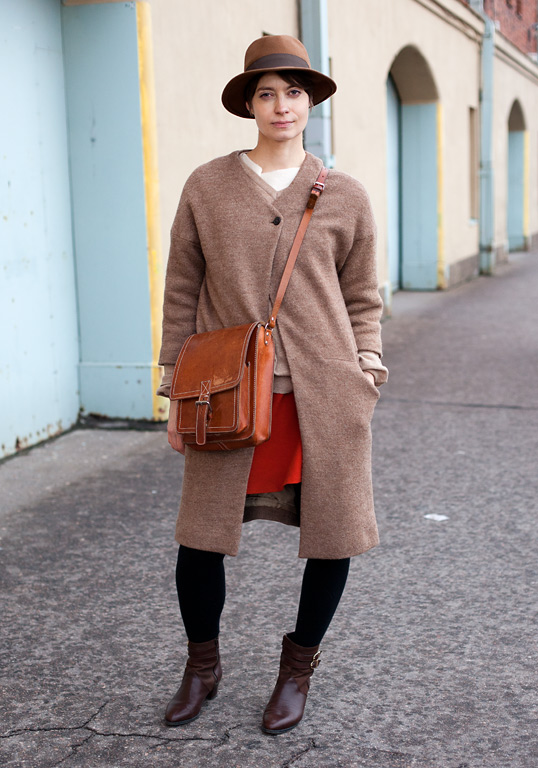
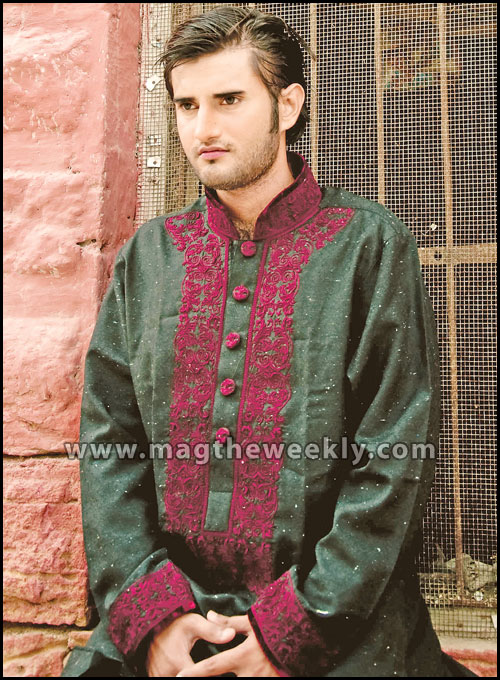
A kurta (Persian/Urdu: کُرتا, also kurti for a shorter version) is a traditional item of clothing worn in Afghanistan, Bangladesh, India, Nepal, Pakistan, and Sri Lanka. It is a loose shirt falling either just above or somewhere below the knees of the wearer, and is worn by both men and women. They were traditionally worn with loose-fitting paijama (kurta-paijama), loose-fitting salwars, tight-fitting churidars, or wrapped-around dhotis but are now also worn with jeans. Kurtas are worn both as casual everyday wear and as formal dress.
Women often wear kurtis as blouses, usually over jeans.[2] These kurtis are typically much shorter than the traditional garments and made with a lighter materials, like those used in sewing kameez.
Imported kurtas were fashionable in the 1960s and 1970s, as an element of hippie fashion, fell from favor briefly, and are now again fashionable. South Asian women may also wear this Western adaptation of South Asian fashion.
Formal kurtas are usually custom-made by South Asian tailors, who work with the fabric their customers bring them. South Asians overseas and Westerners, can buy them at South Asian clothing stores or order them from web retailers.
A traditional kurta is composed of rectangular fabric pieces with perhaps a few gusset inserts, and is cut so as to leave no wasted fabric. The cut is usually simple, although decorative treatments can be elaborate.
The sleeves of a traditional kurta fall straight to the wrist; they do not narrow, as do many Western-cut sleeves. Sleeves are not cuffed, just hemmed and decorated.
The front and back pieces of a simple kurta are also rectangular. The side seams are left open for 6-12 inches above the hem, which gives the wearer some ease of movement.
The kurta usually opens in the front; some styles, however, button at the shoulder seam. The front opening is often a hemmed slit in the fabric, tied or buttoned at the top; some kurtas, however, have plackets rather than slits. The opening may be centered on the chest, or positioned off center.
A traditional kurta does not have a collar. Modern variants may feature stand-up collars of the type known to tailors and seamstresses as "mandarin" collars. These are the same sort of collars seen on achkans, sherwanis, and Nehru jackets.